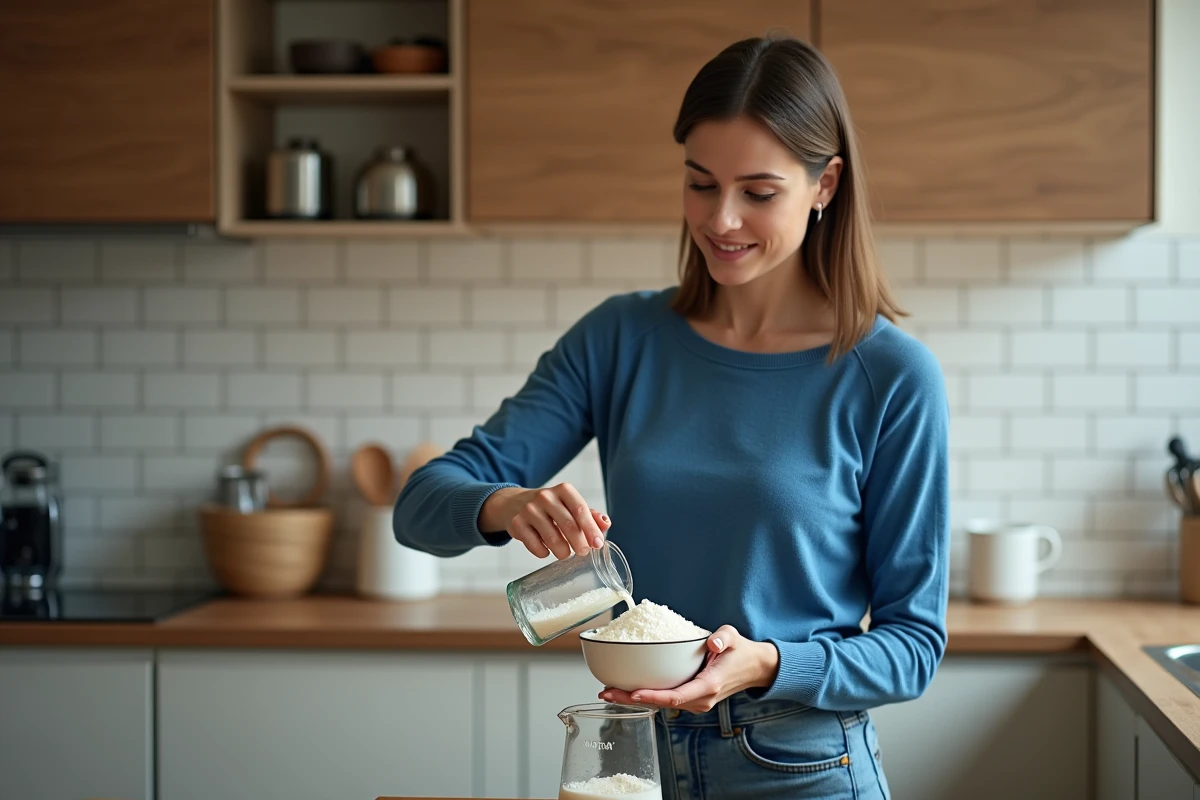
One gram of pure water is exactly equivalent to one milliliter, while one gram of flour or sugar yields a very different volume. Direct conversions between grams and milliliters only work with certain ingredients.
Density varies according to the nature of the measured product. The same weight, 150 g, occupies a variable space depending on whether it is milk, oil, or cocoa powder. Ignoring this difference leads to frequent mistakes when preparing recipes.
Why 150 g does not always equal 150 ml in cooking: understanding the difference between mass and volume
In cooking, confusing mass and volume leads straight to a false note. 150 g of sugar does not take up the same space as 150 g of water, and it is even more pronounced with flour. It all depends, in reality, on density: a value specific to each ingredient that disrupts reflexes and makes all the difference.
Water, in this regard, is like a textbook case. Its density is exactly 1 g per ml: impossible to go wrong. You pour 150 g, you get 150 ml, it’s as simple as that. But leave the pitcher and you enter another world: milk, for example, has a density of 1.03 g/ml, which slightly reduces the volume needed for the same mass. Oil reverses the trend, taking up more space: about 0.92 g/ml. Try it with flour, and you’ll see your measuring cup fill up before your eyes: nearly 300 ml for 150 g.
The infallible rule: volume = mass ÷ density. Whether it’s a pastry or a dinner dish, returning to this formula protects against many disappointments. Useful links, like this conversion of 150 g to ml, really make life easier in the kitchen when you want to gain accuracy. Between grams and milliliters, it is therefore not just a simple game of numbers but a decisive choice for the success of a recipe.
Be careful: density is not fixed. Depending on humidity, the nature or state of the ingredient, values fluctuate. Light flour does not have the same density as a packed bag. Creamy honey takes up less space than liquid honey. Adopting this rigor transforms each recipe into a guaranteed success.
What does 150 g correspond to in ml for the most common ingredients?
You don’t convert 150 g to ml with your eyes closed. Each time, you need to know the specific density of the ingredient.
For water, it’s pure classic: 150 g equals 150 ml. Wheat flour, with its low density (about 0.55), reaches nearly 270 ml for the same mass. Powdered sugar, on the other hand, only requires 180 ml. Sunflower oil needs 163 ml. Milk requires 146 ml, while honey, being more concentrated, occupies only 109 ml for 150 g.
To clarify, here are some concrete benchmarks for common values:
- Water: 150 ml
- Milk: 146 ml
- Sunflower oil: 163 ml
- Wheat flour: 270 ml
- Powdered sugar: 180 ml
- Honey: 109 ml
As for melted butter, it corresponds to 160 ml for 150 g. A dash of soy sauce or balsamic vinegar? It ranges between 145 and 150 ml, depending on the brand and temperature. Referring to a detailed chart or the density of the product helps avoid discrepancies, especially when baking requires near-scientific precision.

Practical tips for easily converting 150 g to ml in your everyday recipes
Failing a recipe due to conversion leaves a bitter taste. When the scale is not there or the measuring cup is nowhere to be found, a few benchmarks make the task more serene. Keeping in mind the formula “volume (ml) = mass (g) ÷ density” is helpful, but you still need to have the correct density at hand.
Some choose to slip a conversion chart into their drawer or on the fridge door. It includes the usual measurements for water, milk, flour, sugar… Handy, especially if you want to quickly convert 150 g to ml.
In the absence of precise equipment, improvisation comes into play in the kitchen: a measuring cup or a tablespoon often helps. For reference, a tablespoon contains 15 ml of water or around 8 to 10 g of flour. A simple yogurt pot (125 ml) also provides a useful reference. You get closer to the result, although nothing beats the precision of a scale, especially for sweets where every detail counts.
Cooking does not adhere to universal rules: behind each conversion lies the unique reality of each ingredient. Accuracy is found in these subtleties, and it is often there that the thrill of success or the wink of a perfectly risen cake is tied up.