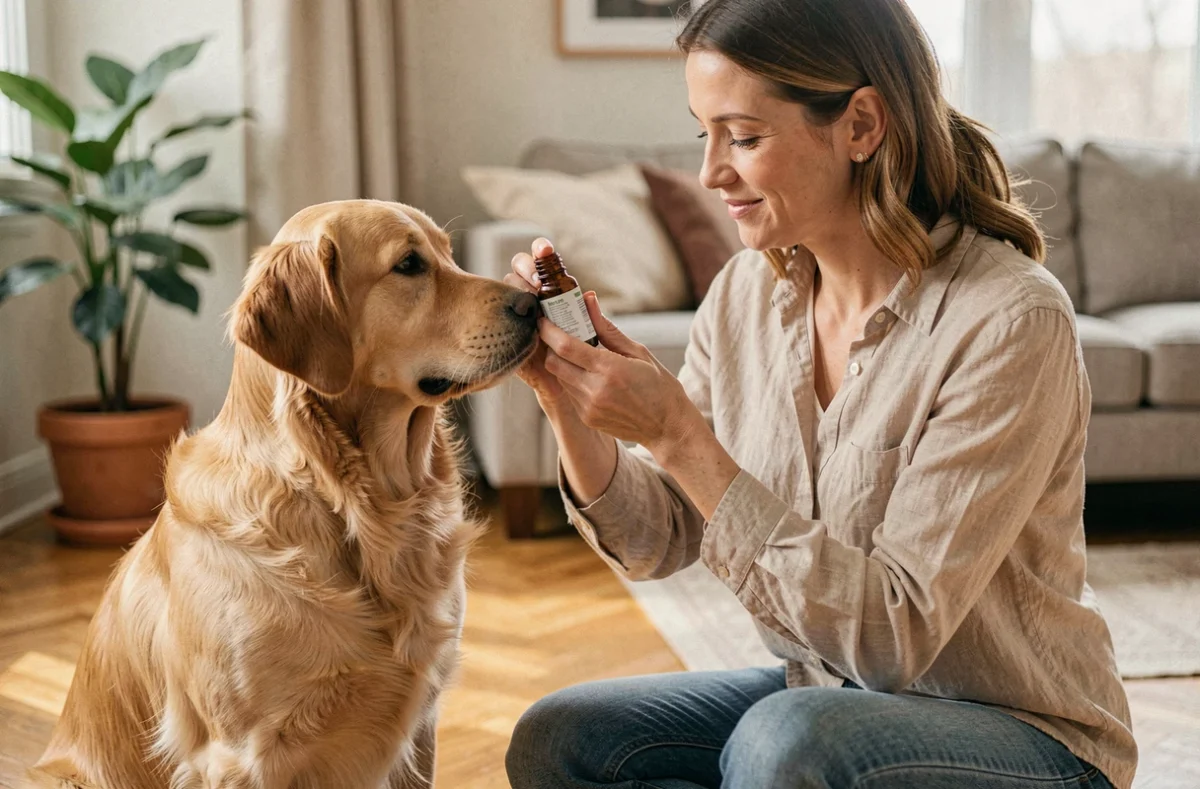
Bach flowers are among the most recommended products on dog owner forums and networks for managing stress, separation anxiety, or fear of noises. These floral elixirs, developed in the 1930s by British physician Edward Bach, are based on the idea that a dilution of wildflowers can rebalance emotions. Their use has expanded to pets, driven by a growing demand for natural solutions.
Bach flowers for dogs: what clinical trials say
Most online content presents Bach flowers as a gentle and risk-free remedy for stressed dogs. Owners often report visible calming after a few days of treatment. These testimonials are sincere, but they do not constitute proof of specific effectiveness.
No robust controlled trial has demonstrated the specific efficacy of Bach flowers in dogs. Regarding fear of noises, for example, calming products (including floral elixirs) do not clearly exceed the expected placebo effect reported by owners, according to an analysis citing the work of Riemer (2020).
The owner administering a product tends to observe their pet differently, to the point of reassuring them more. This increased attention may be enough to modify the perceived behavior.
Canine behavior practitioners on canisessence.com remind us that a dog’s emotional well-being first requires a correct reading of their signals before adding any product. This approach aligns with a shared observation among several behaviorists: identifying the cause of the behavioral issue takes precedence over seeking an immediate remedy.
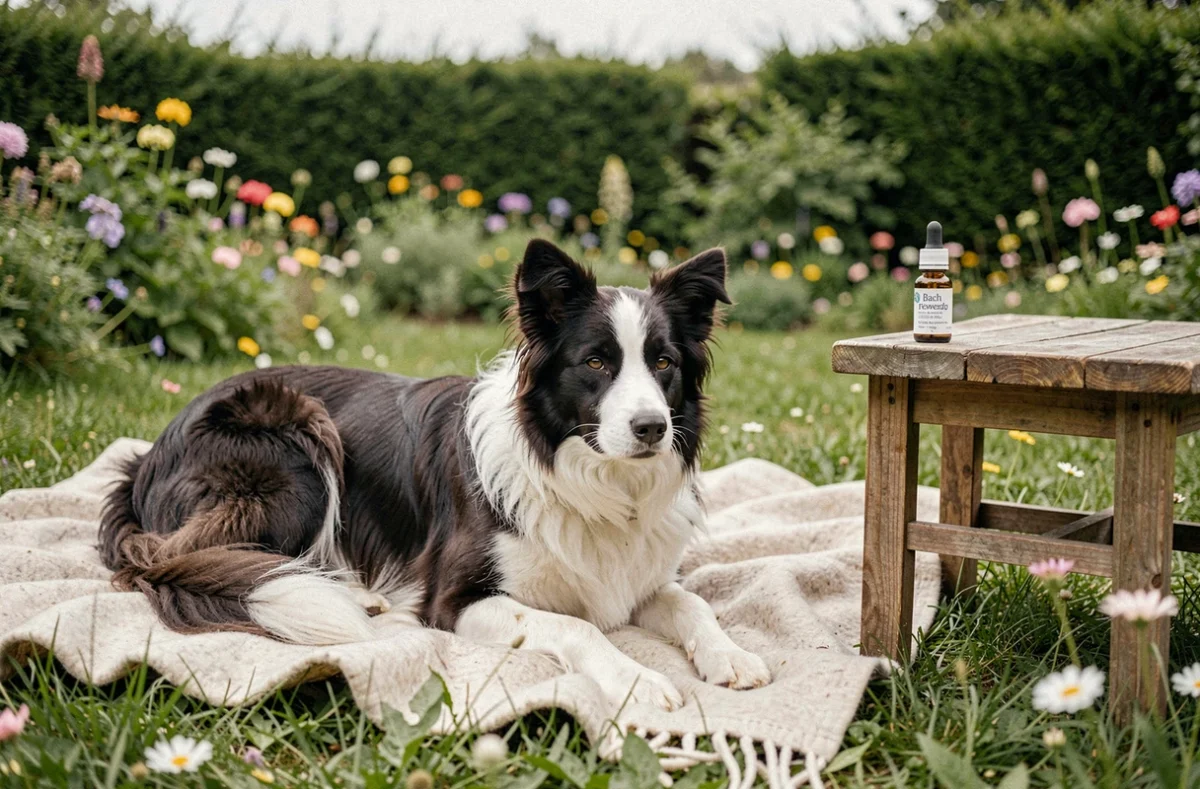
Floral elixirs and dog training: complementarity or confusion
The association between Bach flowers and dog training is based on a common misunderstanding. A dog that destroys things in the absence of its owner, barks excessively, or refuses to walk on a leash does not necessarily express an isolated emotional imbalance. These behaviors often have environmental, relational, or incomplete learning origins.
Administering a floral elixir without analyzing the context is akin to treating a symptom without understanding its source. Field feedback varies on this point: some dog trainers use Bach flowers as a transitional tool for a very anxious dog while establishing a structured behavioral protocol. Others believe this intermediate step delays actual care.
When Bach flowers can support educational work
The most coherent scenario remains that of a dog whose stress level prevents any learning. An animal in a panic during fireworks, for example, cannot integrate a desensitization exercise. In this specific case, Bach flowers serve as a temporary crutch, not an educational solution.
The nuance is crucial. Rescue Remedy (a blend of five flowers) is the most commonly used product in situations of emotional distress in animals. Its calming effect reported by owners can facilitate a working session. However, the available data do not allow us to conclude that this effect exceeds that of a reassuring ritual (calm voice, physical contact, secure environment).
Product form and safety: a often overlooked angle
Bach flowers come in the form of drops diluted in a water-alcohol mixture. This formulation detail raises a concrete question for the animal: the presence of alcohol (brandy) in traditional floral elixirs requires particular vigilance in dogs.
Several manufacturers now offer alcohol-free versions based on vegetable glycerin. For canine use, these alternatives are preferable. Here are the points to check before using a floral elixir on a dog:
- Check the bottle’s composition: prefer formulations without alcohol or with negligible residual content, especially for small breed dogs
- Ensure that the product does not contain significant added oils, sometimes present in “animal wellness” ranges but potentially toxic to dogs
- Follow the dosage recommended by the manufacturer and do not combine multiple elixirs simultaneously without professional advice
Unclear regulatory framework for animal floral elixirs
Bach flowers are neither veterinary medicines nor dietary supplements in the regulatory sense. They therefore escape the efficacy proof obligations imposed on animal health products. No marketing authorization is required to sell a floral elixir intended for animals in France.
This absence of a framework partly explains the proliferation of ranges with varied claims. An owner can purchase a “canine anti-stress” blend without any authority having verified the relevance of this indication. Animal behaviorists recommend treating these products as a possible accompaniment, never as a medical treatment.
Bach flowers and dog anxiety: validated behavioral alternatives
For a dog suffering from separation anxiety or leash reactivity, the methods with the broadest professional consensus rely on gradual desensitization and counter-conditioning. These protocols, supervised by a dog trainer or veterinary behaviorist, produce measurable results over several weeks.
Severe cases (self-mutilation, systematic destruction, continuous vocalizations) require a veterinary diagnosis. An appropriate medication prescribed by a veterinarian then offers a level of proof incomparably superior to that of floral elixirs.
- Gradual desensitization: gradual exposure to the anxiety-provoking stimulus, below the dog’s reaction threshold
- Counter-conditioning: associating the stressful stimulus with a positive experience (treat, play)
- Environmental modification: calm retreat area, predictable routines, daily mental enrichment
Bach flowers do not replace a structured educational protocol or veterinary advice. Their place, if it exists, is as a complement to an approach based on understanding canine behavior. An owner who observes a change after administering a floral elixir would benefit from questioning whether it is the product that is acting, or the increased attention they are giving their pet since deciding to care for it differently.